
History
The airlines and aircraft of Kai Tak
Seven carriers, the jets they flew and how they looked on the apron, with a short history of each.
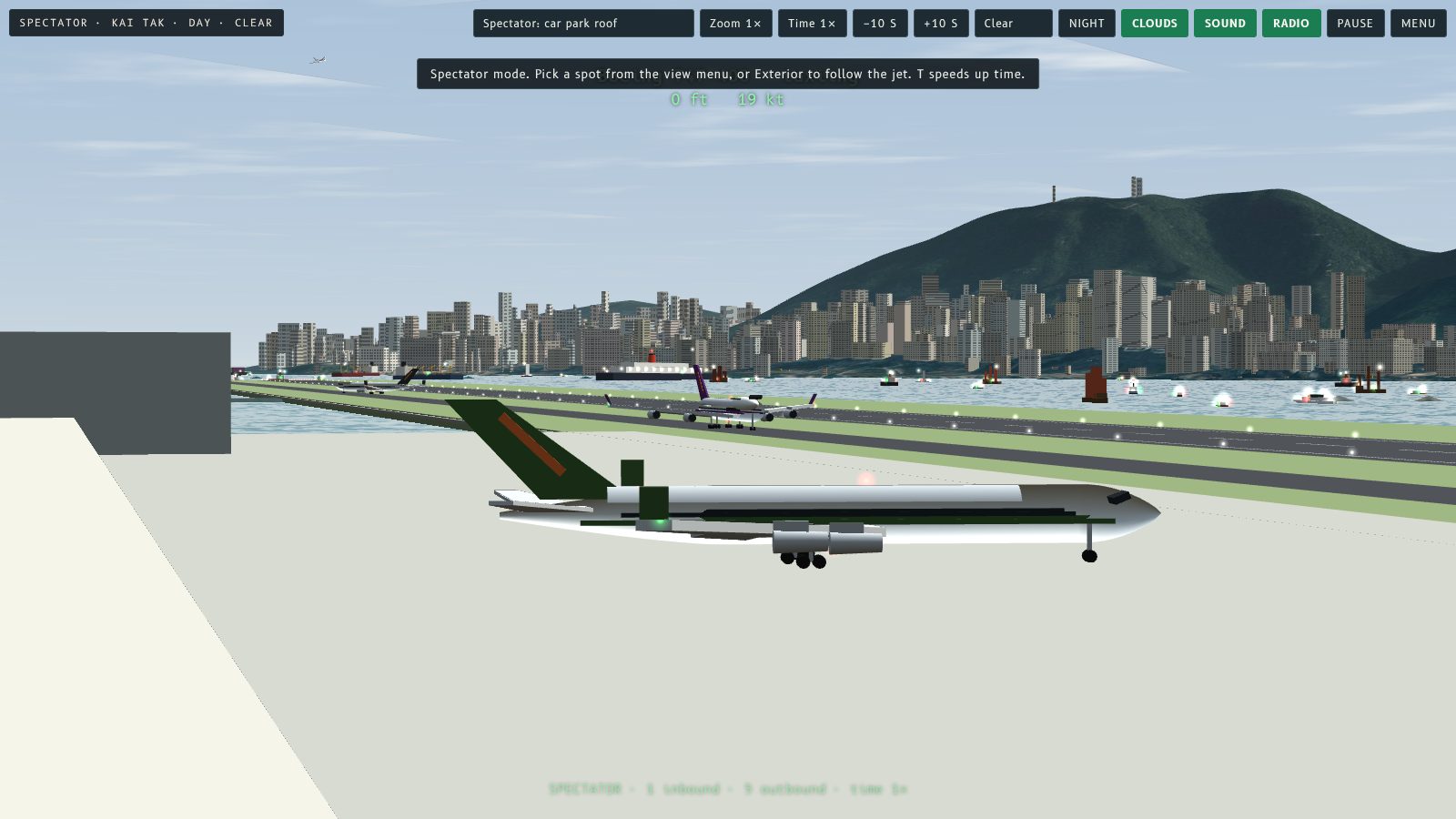
In the 1990s Kai Tak handled a long list of carriers, from the Hong Kong home airlines to flag carriers from Europe, Australasia and Asia. This is a short guide to the airlines you would have seen on the apron, the aircraft they flew and what their jets looked like. Airline names, fleets and liveries are described in words, not drawn, so the sim stays free of brand artwork.
The aircraft you would see
Kai Tak's 47° turn and short final favoured wide-bodies with good low-speed handling. The mix in the 1990s ran from the 747-400 through the 777-200, the A330 and A340, the MD-11, the 767, the A300-600 and the 747-200/300, down to narrow-bodies such as the A320 and the 737 on regional routes. Fly Kai Tak flies the 747-400, 777-200, A330-300 and A340-300 today, with more types on the roadmap.
Cathay Pacific
History. Founded in 1946 by Roy Farrell and Sydney de Kantzow with a single war-surplus DC-3, Cathay Pacific grew with Hong Kong and became the colony's flag carrier. Swire took a major stake in 1948. By 1998 it was the airport's largest operator, and its flights were among the last to leave Kai Tak.
Aircraft. 747-400, 777-200, A330-300 and A340-300.
Livery. A white fuselage with a green cheatline along the windows and a tail carrying the green and white "brushwing", a stylised wing stroke in two tones of green.
Dragonair
History. Hong Kong Dragon Airways was founded in 1985 by shipping magnate Sir Y. K. Pao and partners to give Hong Kong a second home carrier, and it built a network across Asia and into mainland China.
Aircraft. A320 and A330-300, plus older narrow-bodies on short routes.
Livery. A white fuselage with a red tail carrying a dragon emblem.
Qantas
History. Qantas began in 1920 as Queensland and Northern Territory Aerial Services, flying outback mail and passengers before becoming Australia's international carrier. Its name is the old initials, turned into a word.
Aircraft. 747-400 and 767-300 on the Australia routes.
Livery. A white fuselage with a red tail and a white kangaroo, with the company name along the forward fuselage.
British Airways
History. British Airways formed in 1974 when BOAC and BEA were merged, and was privatised in 1987. It had flown to Hong Kong since the BOAC days, and the London run was one of the longest into Kai Tak.
Aircraft. 747-400.
Livery. In 1997 the airline swapped its single tail design for a collection of "world images", so a row of its jets at the terminal showed a different piece of art on each fin above a white fuselage with a dark blue belly.
Singapore Airlines
History. Singapore Airlines began in 1972 when Malaysia-Singapore Airlines split in two. It built a name for service and for new aircraft, and flew to Hong Kong almost from the start.
Aircraft. 747-400 and 777-200, with smaller twins on some rotations.
Livery. A pale, silver-white fuselage with a dark blue cheatline, a dark blue tail and a stylised yellow bird.
Thai Airways International
History. Thai Airways was founded in 1960 and became the Thai national carrier, gaining full government ownership in 1977 and merging with its domestic arm in 1988. Bangkok to Hong Kong was a busy trunk route.
Aircraft. A300-600, 747-400 and MD-11.
Livery. A white fuselage with a sweep of purple, magenta and gold stripes that rise onto the tail, which gave the jets a very bright look on the apron.
Japan Airlines
History. Japan Airlines was founded in 1951 and became the flag carrier in 1953. Its Tokyo and Osaka services to Hong Kong were among the busiest in Asia.
Aircraft. 747-400 and DC-10.
Livery. A white and grey fuselage with a red crane inside a circle on the tail, a design that has been its signature for decades.
And many more
The apron also saw carriers such as Air New Zealand, Korean Air, China Airlines, EVA Air, KLM, Lufthansa, United and Northwest, as well as cargo operators. After Kai Tak closed on 6 July 1998, every flight moved to the new airport at Chek Lap Kok.
A note on the sim. Fly Kai Tak keeps its aircraft in its own colours and does not show airline logos or real liveries. The descriptions above are for reading only.
九十年代,啟德機場有好多航空公司升降,由香港本地航空公司,到歐洲、澳洲同亞洲嘅國家航空公司都有。呢篇簡單介紹當年停機坪上面見到嘅航空公司、佢哋飛嘅機型,同埋飛機嘅外觀。航空公司名稱、機隊同塗裝只用文字描述,唔會畫出嚟,令模擬器冇品牌圖案。
你會見到嘅機型
啟德機場要喺短航道入面做 47° 轉彎,所以啱用低速操控好嘅寬體客機。九十年代嘅機型包括 747-400、777-200、A330 同 A340、MD-11、767、A300-600 同 747-200/300,區內航線亦有 A320 同 737 呢啲窄體機。Fly Kai Tak 而家可以飛 747-400、777-200、A330-300 同 A340-300,之後仲會加更多機型。
國泰航空
歷史。國泰航空喺 1946 年由 Roy Farrell 同 Sydney de Kantzow 用一架戰後剩餘嘅 DC-3 創辦,之後同香港一齊成長,成為香港嘅代表航空公司。太古喺 1948 年成為大股東。到 1998 年,國泰係機場最大嘅營運商,佢哋嘅航班亦係最後離開啟德嘅其中一批。
機型。747-400、777-200、A330-300 同 A340-300。
塗裝。白色機身,窗口旁有一條綠色飾帶,尾翼係綠白兩色嘅「brushwing」,好似一筆風格化嘅機翼。
港龍航空
歷史。港龍航空喺 1985 年由船王包玉剛爵士等人創辦,目標係令香港有第二間本地航空公司,之後建立咗遍及亞洲同中國內地嘅航線網絡。
機型。A320 同 A330-300,短途航線仲有較舊嘅窄體機。
塗裝。白色機身,紅色尾翼,上面有一個龍嘅標誌。
澳洲航空
歷史。澳洲航空喺 1920 年創辦,原名 Queensland and Northern Territory Aerial Services,最初飛內陸嘅郵件同乘客,後來成為澳洲嘅國際航空公司。Qantas 呢個名係舊時縮寫變成一個字。
機型。往來澳洲航線用 747-400 同 767-300。
塗裝。白色機身,紅色尾翼,上面有一隻白色袋鼠,前機身寫住公司名。
英國航空
歷史。英國航空喺 1974 年由 BOAC 同 BEA 合併而成,1987 年私有化。佢哋由 BOAC 時代開始已經飛香港,倫敦航線係飛啟德最長嘅其中一條。
機型。747-400。
塗裝。1997 年佢哋唔再用單一尾翼設計,改用一系列「世界圖像」,所以幾架飛機喺客運大樓排開,每個尾翼都係唔同嘅藝術圖案,下面係白色機身同深藍色機腹。
新加坡航空
歷史。新加坡航空喺 1972 年馬來西亞—新加坡航空分拆之後成立,以服務同新飛機聞名,幾乎一開始就飛香港。
機型。747-400 同 777-200,部分航班用較細嘅雙引擎機。
塗裝。淺銀白色機身,深藍色飾帶,深藍色尾翼,上面有一隻黃色風格化嘅鳥。
泰國國際航空
歷史。泰航喺 1960 年創辦,成為泰國嘅國家航空公司,1977 年由政府全資擁有,1988 年同國內航空公司合併。曼谷至香港係一條繁忙嘅幹線。
機型。A300-600、747-400 同 MD-11。
塗裝。白色機身,紫色、洋紅同金色嘅條紋一路上到尾翼,喺停機坪上面好鮮艷。
日本航空
歷史。日本航空喺 1951 年創辦,1953 年成為國家航空公司。佢哋由東京同大阪飛香港嘅航班,係亞洲最繁忙嘅其中幾條航線。
機型。747-400 同 DC-10。
塗裝。白灰色機身,尾翼有一隻圓圈入面嘅紅色鶴,呢個設計已經用咗幾十年。
仲有好多
停機坪上面仲見到紐西蘭航空、大韓航空、中華航空、長榮航空、荷蘭皇家航空、漢莎航空、聯合航空同西北航空,以及貨運公司。啟德機場喺 1998 年 7 月 6 日關閉之後,所有航班都遷往赤鱲角新機場。
模擬器嘅說明。Fly Kai Tak 嘅飛機用自己嘅顏色,唔會顯示航空公司標誌或者真實塗裝。上面嘅描述只係用嚟睇。
More from the blog
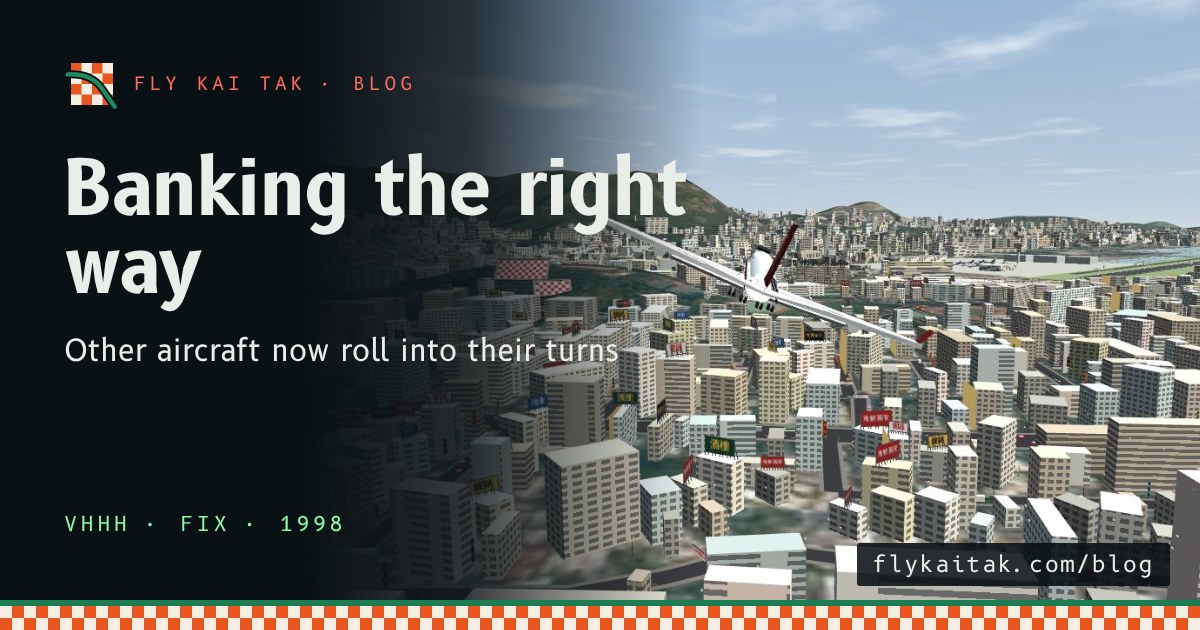
Other aircraft now bank the right way
Fly Kai Tak fix: other aircraft were drawn banking the wrong way in turns. Arrivals and departures now dip the inside wing, as real jets do.
Read the post →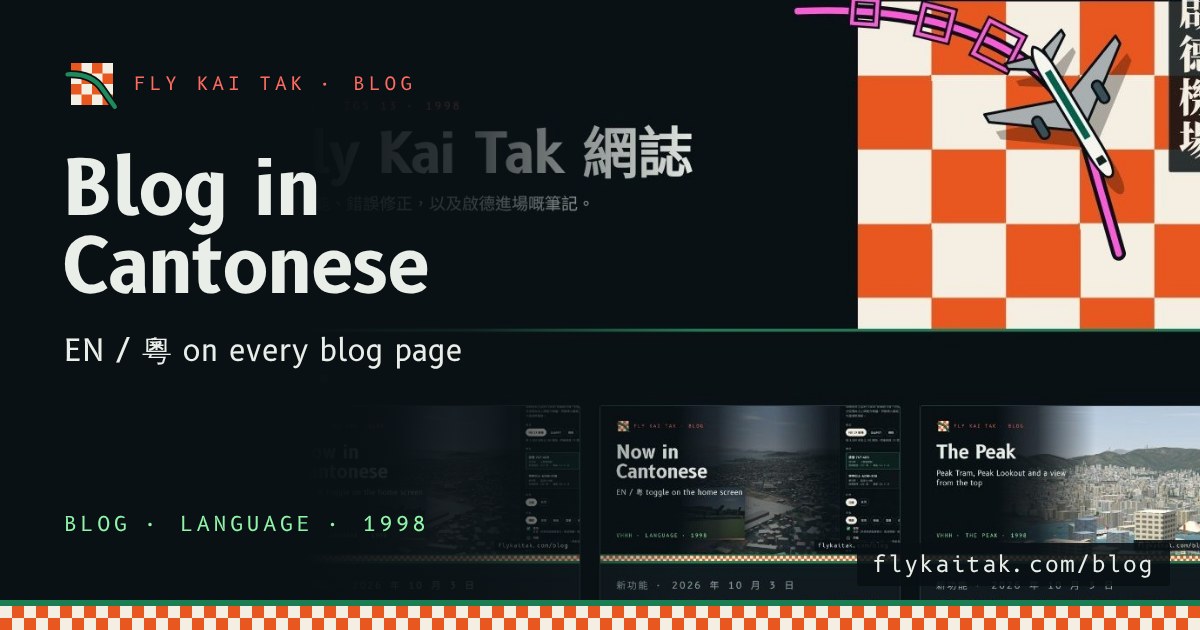
Read the Fly Kai Tak blog in Cantonese
The Fly Kai Tak blog now has an English / Cantonese toggle on every page: posts, captions, header and footer switch to written Cantonese.
Read the post →